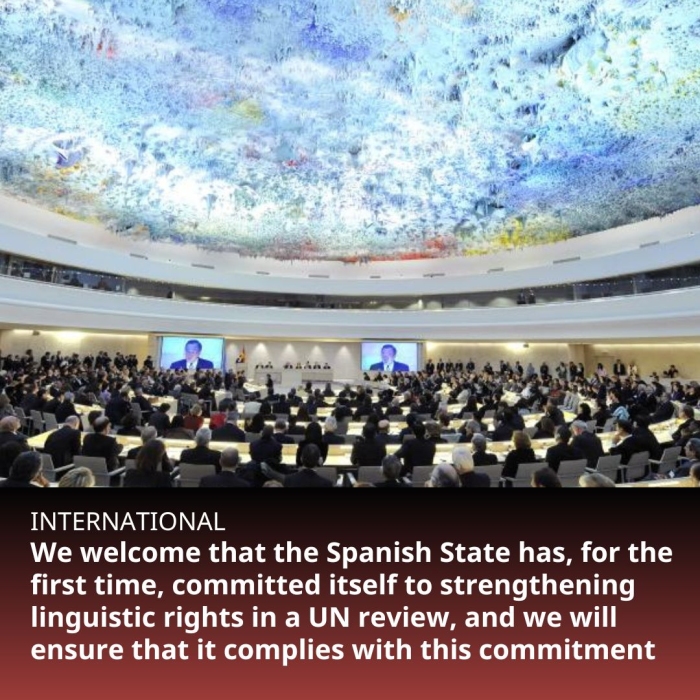


Plataforma per la Llengua celebrates Spain's commitment, in the framework of the Universal Periodic Review (UPR) of the UN Human Rights Council, to strengthen the rights of indigenous linguistic communities for the first time. The organisation has been present at the review sessions, which have taken place in Geneva, and urges the Spanish State to immediately implement its commitments. Òscar Escuder, president of Plataforma per la Llengua, will be speaking in Geneva on Monday as part of the general debate, which will bring this cycle of reviews, in which some fifteen states have been evaluated, to a close.
Specifically, Spain has committed to following the recommendations on linguistic rights that Plataforma per la Llengua secured, for the first time, from other states. This is within the framework of this United Nations review, in which states evaluate each other every four and a half years to analyse their degree of compliance. On this occasion, four states (Austria, Ireland, Samoa, and the Republic of the Marshall Islands) asked it to promote linguistic diversity, protect the human rights of linguistic minorities and prohibit discrimination on the basis of language in law. They also asked it to safeguard cultural rights by promoting education and the practice of these minority languages, to strengthen efforts to combat hate crimes against national, ethnic, religious and linguistic minorities (including on the Internet) and to combat all forms of racism, heeding the rapporteur's recommendations.
This organisation for the defence of the Catalan language welcomes this development, particularly since no state has previously made recommendations regarding linguistic rights during any Universal Periodic Review of Human Rights. On this occasion, Plataforma per la Llengua increased international pressure to denounce the violations of these rights in Spain (as outlined in a report presented in October) and met with representatives from different states to urge them to adopt the organisation's recommendations to guarantee these rights. Finally, on 30 April, when Spain underwent the hearing in which states could make recommendations, four asked the Spanish State to specifically respect linguistic rights.
Maria de Lluc Muñoz, Head of International Affairs at Plataforma per la Llengua, participated in today's session at the Palais des Nations in Geneva and announced that the organisation has taken note of the commitments made by the Spanish State and urges it to comply with them immediately. The organisation considers that, although the recommendations are not legally binding, they carry significant political and diplomatic weight. Their acceptance is an important step in the recognition and defence of the linguistic rights of Catalan speakers. Of the 324 recommendations made, the State has fully accepted 303 and partially accepted 3. It has agreed to all of those relating to linguistic rights.
However, Plataforma per la Llengua reiterates that the Spanish State does not fully respect the rights of its indigenous linguistic communities. These violations contradict international standards, including the principles of equality and non-discrimination that underpin the Universal Declaration of Human Rights. Catalan speakers face barriers when wanting to access the justice system in Catalan They are systematically discriminated against on linguistic grounds by state authorities, the language is being pushed back in compulsory education, and hate speech against Catalan speakers goes unpunished. The organisation's president, Òscar Escuder, will speak on Monday during the general session of the UPR.
International pressure to promote Catalan and defend linguistic rights
Plataforma per la Llengua works internationally, through international networks and by participating in mechanisms such as this one, to compel all international actors to urge the Spanish State to protect Catalan and the rights of Catalan speakers. In addition to meeting with representatives from various states, following the last session of the UPR, the organisation met with the UN Special Rapporteur on Minorities, the Swiss expert Nicolas Levrat, and reiterated the recommendations that the organisation has been making to international institutions.
Specifically, Plataforma per la Llengua recommends that Spain take measures to prosecute linguistic discrimination perpetrated by public servants. It also recommends that Spain include the Catalan-speaking minority as a protected group in the signing of the Council of Europe's Framework Convention for the Protection of National Minorities. Furthermore, it strongly recommends that the Spanish State adopt legislation to recognise the rights of speakers of official languages other than Spanish to be able to use them with employees of the general State administration and the justice system, and that it complies with the recommendations of the European Charter for Regional or Minority Languages (CELRoM) and the UN Special Rapporteur. Most notably, it calls for changes to Article 231 of the Organic Law on the Judiciary, which stipulates that officials must use Spanish in court proceedings and that "co-official minority languages" will only be permitted if no party objects. In addition, Plataforma per la Llengua recommends that the Spanish State take measures to ensure that children can be educated in Catalan and that hate speech on the Internet and in other media against Catalan speakers and the Catalan language be investigated, prosecuted, and punished.