

SGÔR - the 2nd International Symposium on Minoritised Languages and Football, held in Barcelona on Monday and Tuesday, has demonstrated football's key role as an informal leisure space with great potential for helping normalise minoritised languages. Organised by Plataforma per la Llengua with the cooperation of the European Center for Minority Issues (ECMI) and with the support of the Government of Catalonia and the Government of Wales, the event has brought together experts, club representatives and researchers from all over Europe, who have all pointed out that the social use of languages also comes into play outside institutional spheres, and in football in particular.
With more than 100 attendees, this was the second SGÔR symposium - the first was held last year in Wales and the third is planned for next year. It served to share the linguistic best practices of different football clubs in Europe and to take an in-depth look at fans' attitudes towards language, language activism in sport, youth football, and the role of the media in sporting communication. A specific space for local councils from the ImpliCat network was also organised as part of the symposium, allowing them to take on some of the lessons from the conference and turn them into real language policies for municipal sporting spaces.
Òscar Escuder, president of Plataforma per la Llengua, opened the symposium and took part in a round table with the president of the European Language Equality Network (ELEN) and coordinator of the first SGÔR, Elin Haf Gruffydd Jones; the deputy director of sport for the Welsh government, Steffan Roberts; and Craig Willis, a researcher from the European Center for Minority Issues (ECMI). The speakers stressed that, beyond formal language learning in schools, the process of normalising minoritised languages requires the transfer of the language in question into individuals' informal socialisation spaces. That is why sport and football have a fundamental role in normalising Catalan and all minoritised languages.
Catalan in the Spanish first division, and language clauses in contracts
In the first round table, the director elect of Futbol Club Barcelona, Elena Fort; the director of International Relations of RCD Espanyol de Barcelona, Xavier Andreu; and the director Girona FC, Nacho Mas-Bagà, proclaimed the commitment of all three clubs to promoting Catalan and emphasised the need to raise the profile of newcomers who learn the language, such as Michel, from Madrid, who is coach of Girona; Manolo González, the coach of Espanyol, and the Barça player Fermín López. Moderated by Ariadna Mas, a member of the Plataforma per la Llengua's executive committee, all three speakers also talked about the linguistic balancing act they attempt in order to reach audiences all over the world. Elena Fort also pointed out that Barça is not ruling out including a clause in players' contracts to make them learn Catalan.
Clubs' best language practices
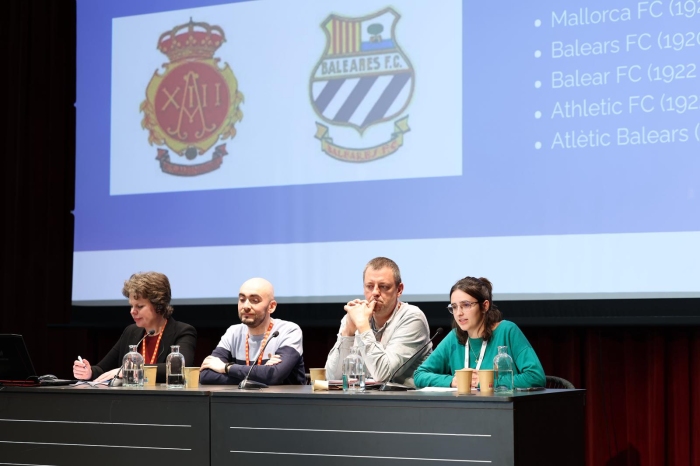
The second round table analysed different communication practices by European clubs with minoritised languages. Dr Jelske Dijkstra presented the case of Frisian at SC Heerenveen, a Dutch club which, although it does not have a specific language policy, shows a clear desire to involve the whole Frisian language community and incorporates Frisian in its external communications. Professor Cristòfol Tripiana set out the case of Catalan at Villarreal, a club that has only recently achieved sporting success. However, the positioning of the board makes it difficult to link it to the Catalan language and identity (the club does not even want to reflect the official historical name of the city it represents in the name of the sporting institution). Dr Sergiusz Bober spoke of two individual cases: Silesian at Ruch Chorzów and Kashubian at Arka Gdynia. Although neither of the two clubs has a formal language policy, they show very interesting initiatives, such as the establishment of "specific language advice", the celebration of local holidays and the sale of specific merchandise. Finally, Maria de Lluc Muñoz, international officer for Plataforma per la Llengua, analysed the case of Catalan at CE Atlètic Balears, a club in a context of linguistic decline, where there is a clear battle going on between fans' intentions and the interests of the board.
Fans and minoritised languages
On Monday afternoon, it was time to analyse fans' attitudes to language. Helena Barrufet presented the case of Catalan among fans of Sant Andreu, a club of humble origins whose fans have a fundamental role in protecting and socialising Catalan. Sami Koskelainen introduced the case of Swedish in Finnish football, demonstrating the need to establish language policies that make theoretical legal bilingualism into something real. Penny Miles spoke of transformations in the Welsh linguistic landscape since 2016: through observation and analysis of interviews, Miles has been able to demonstrate the way in which the promotion of Welsh has led to normalisation in international contexts. Meanwhile, Craig Willis set out the complex management of the dual monolingualism among fans of FC Südtirol, a club competing in the Italian second division and followed by two rival language groups, to the point where Italian-speaking supporters even call the club by a different name: Alto Adige.
Language activism in football
Monday's final talk presented different initiatives in the world of football to activate the use of languages, as well as language activism. Myriam Vellinga spoke of specific projects through which her association, Afûk, promotes the Frisian language. The association also transformed the language landscape of some football clubs' stadiums and helped raise the profile of the language, encouraging members of the public and businesses to champion it. The president of the Pyrenees-Mediterranean Euroregion, Xavier Bernard-Sans, referred to the CREOCCAT project, which facilitates cooperation between clubs from Catalan-speaking regions, despite the clear limitations imposed by the legal framework for cooperation. The psychologist Aritz Olagoi shared with attendees his methodology for promoting Basque through training coaches. Taking a practical view, Olagoi explained the different stages through which it is possible to work to promote languages through coaches over an entire season.
The importance of youth football for language normalisation
On Tuesday it was the turn of youth football and the media. After an introduction by the director of Plataforma per la Llengua, Rut Carandell, a round table reviewed different language experiences at clubs in children's and youth football. Lana St Leger explained that, despite the official status of Welsh in Wales, young people's language habits strongly depend on their social environment and peer groups and she advocated its use in leisure spaces like football without worrying too much about linguistic correctness. Rubén Cepeda presented the case of CE Júpiter as a social transformation project promoting an integrated plan, at the hands of Plataforma per la Llengua, to strengthen Catalan in all club dynamics. Ramon Ortiz highlighted the key role of CE Europe coaches in making Catalan a language of leisure through incorporating it in a friendly way across the board. Estela Mas, a councillor from Mollet del Vallès, underlined the need for public policies to support clubs in a context where Catalan had lost social presence outside school. Oleguer Presas offered the La Caserna Football School in Sabadell as a community model, integrating Catalan as a vehicular language through education for families, codes of conduct and socialisation spaces.
The critical role of the sporting media
Before the day was closed by the vice-president of Plataforma per la Llengua, Mireia Plana, and the speech by the Government of Catalonia's Minister of Language Policy, F. Xavier Vila, there was a final round table. Yuri Carrazoni highlighted the experience of Nós Diario as the only newspaper covering top-level football in Galician, championing its professionalism and competitive offer in overcoming the hegemony of Spanish; Elin Haf Gruffydd Jones stressed that media in minoritised languages are crucial for generating cohesion, identity and linguistic models, also through sport; Gemma Mallorca upheld the 3Cat model, positioning Catalan as the vehicular language with its own emotional narrative capable of reaching all audiences; and Miquel Agut, of RAC1, noted the media's function in providing examples, advocating genuine, ambitious, present use of Catalan at big events to strengthen its prestige and social normalisation.