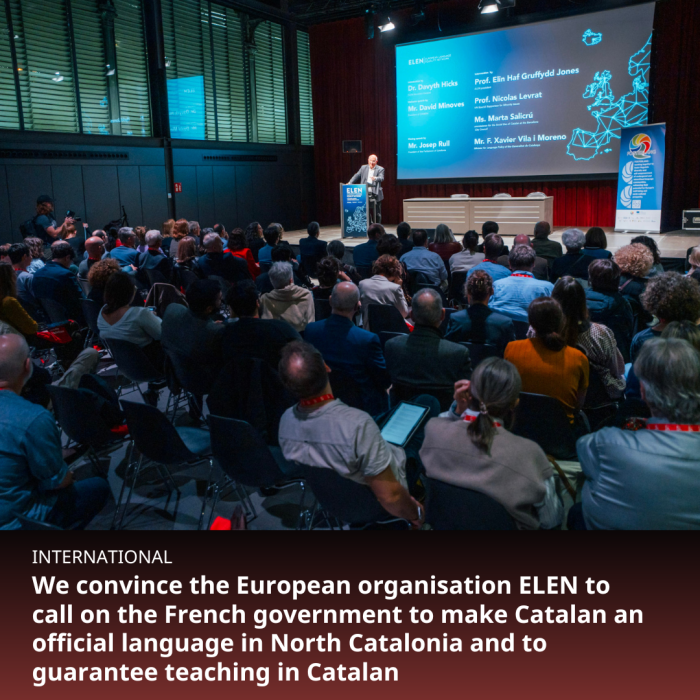


Plataforma per la Llengua took part in the General Assembly of the European Language Equality Network (ELEN) in Barcelona and convinced the organisation to unanimously approve two resolutions to protect Catalan in North Catalonia: the first to promote the official status of the language in the region and the second to ensure it is learned in schools. The organisation also took part in a round table on the capacity of social media and internet language promotion campaigns to increase the visibility and social use of minoritised languages.
As for the resolutions approved put forward by Plataforma per la Llengua, the first deplores the structural legal discrimination suffered by Catalan deriving from the French legal framework, proclaiming French as the only language of the Republic (Art. 2), marginalising the so-called "regional" languages and restricting their presence in the administration, education and public life. The text recalls that 87% of the inhabitants of North Catalonia and 77% of the French population support the official recognition of the country's territorial languages, including Catalan, and laments the fact that this social legitimacy is in contrast with the lack of legal recognition and with decades of language assimilation policies.
Because of all this, the resolution calls for the amendment of Article 2 of the Constitution to make Catalan and the other languages of the French State official, to amend the Toubon Law (1994) and all other regulations that make it impossible to normalise the situation, and to apply measures against language discrimination.
A second resolution, also approved at the instance of Plataforma per la Llengua, deplores the fact that public education offered in Catalan in North Catalonia is insufficient and the situation has not improved. The percentage of pupils who have contact with Catalan has increased by just one percentage point in 33 years (from 30% in 1992 to 31% in 2025); the bilingual model is receding and is being replaced by initiation sessions of 30-45 minutes week; only 6% of pupils study bilingually and only 2.5% with full immersion in Catalan; and the number of pupils who choose Catalan in secondary school is a residual 2.7%. The text recalls that French legislation - especially Article 2 of the Constitution and the decision of the Constitutional Council against the Molac Law - severely limit Catalan's capacity to be a language of education and urges the French authorities to make a commitment to the language. Without far-reaching political changes, Catalan could disappear in one or two generations, as even the French Senate has warned.
To prevent this, the resolution calls on French institutions to guarantee universal access to bilingual French-Catalan public education from nursery to baccalaureate, replace short initiation sessions with structured lessons allowing real competence to be achieved; boost teacher training and hire more Catalan teachers; guarantee specific funding for teaching the language; recognise Catalan as a baccalaureate examination subject; and improve information about Catalan and its visibility in the education system.

ELEN General Assembly
The European Language Equality Network (ELEN) is a non-profit European network whose aim is to promote, protect and ensure the welfare of the least spoken European languages. It works for the linguistic equality of these languages in the context of upholding human rights. ELEN intends to be the voice of the speakers of these languages and has 174 member organisations representing 50 languages from 25 different European States.
At this General Assembly, which started on Friday 14 November and lasted until Sunday, the main theme was digital technology, social media and the future of language protection in Europe. There were sessions on online activism, the effect of the housing situation on language communities, the development of ELEN's youth movement and the updating of the Universal Declaration of Language Rights, and various workshops about language technology and social media, as well as immersive education systems.
Plataforma per la Llengua also took part in a round table on the capacity of social media and internet language promotion campaigns to increase the visibility and social use of minoritised languages. The head of the organisation's press office, Jordi Alabern, explained some of the projects Plataforma per la Llengua is working on. He spoke alongside Ernest Montserrat, of Òmnium Cultural; Albert Badosa, of the HIGA get-together for young speakers of minoritised languages; Louis Albert Becker of Youth of European Nationalities; Jordi Garrell, of CIEMEN; and Kasia Wojtylak, of the University of Warsaw. Three content creators also took part: Blanca Trull Armengol, Welmoed Sjoerdstra (from Frisia) and Dessie Donnelly (from Ireland).
View this post on Instagram