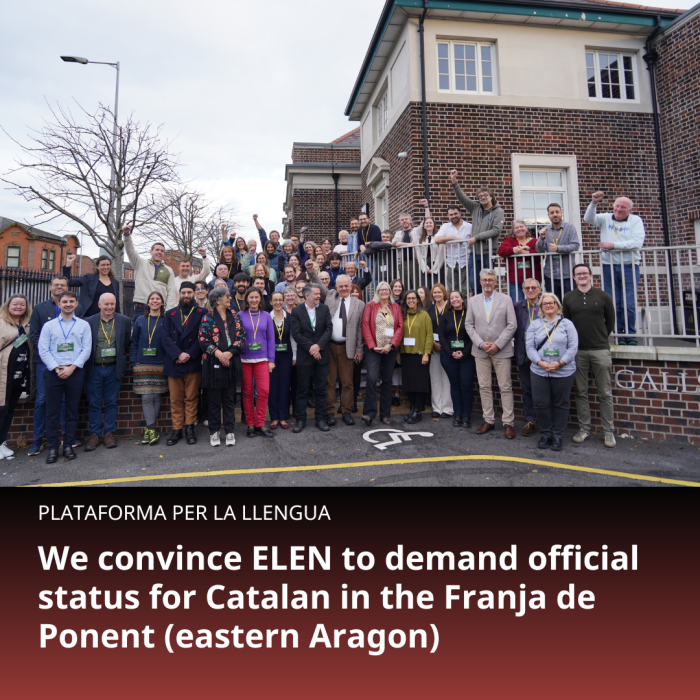


Plataforma per la Llengua has convinced the European Language Equality Network (ELEN), the main European network for the protection of minoritised languages, to approve unanimously a resolution to protect Catalan in the Franja de Ponent. The text, approved on Saturday by the organisation's general assembly, held in Béal Feirste/Belfast (Ireland), calls for the official recognition of Catalan in the Catalan-speaking areas of Aragon and for the right to education in Catalan at all school levels to be guaranteed. The assembly has also approved a European manifesto on housing and minoritised languages, which, among other measures, calls for language impact studies for big urban development schemes, anti-gentrification policies, and greater regulation of tourist accommodation and second homes.
The resolution in favour of Catalan in the Franja de Ponent urges the Aragonese and Spanish governments to apply the recommendations of the Committee of Experts of the Council of Europe's European Charter for Regional or Minority Languages (ECRML). In 2024, the Committee of Experts called for urgent measures to protect and promote Catalan in Aragon, a language explicitly recognised by name in the Aragonese Statute of Autonomy.
For Plataforma per la Llengua, the approval of the resolution provides new European backing for the demands of Catalan-speakers in the Franja de Ponent and obliges the authorities to act urgently to reverse the vulnerable situation of language following decades when there has been no institutional recognition lasting decades.
Deploring policies that marginalise Catalan
The resolution warns that Catalan is still without official status in the Franja de Ponent even though it is the historical language of the region and the most spoken language there. It also recalls that in 2013 the Government of Aragon repealed the law that explicitly recognised Catalan and Aragonese as the languages of the region, replacing the name "Catalan" with the expression "Aragonese language of the eastern area", LAPAO for short. This decision was a clear attack on the unity of the Catalan language and the resolution considers it as an attempt to deny the linguistic identity of the population of the Franja.
The text also deplores the fact that in 2024 the Aragonese government abolished the Directorate General of Language Policy and points out that the lack of institutional commitment has limited the development of effective policies to ensure that the language is passed on to new generations.
As the text recalls, sociolinguistic statistics show a fall in the use of Catalan and indicate that, although it is the most used language in the Franja, its interpersonal use has dropped in the last few decades. In fact, the most recent studies warn of a loss of intergenerational transmission and an increase in the replacement of the language by Spanish among young people.
Guaranteeing pupils can study in Catalan
One of the central elements of the resolution approved is the demand for pupils in the Franja to have the option to be taught entirely in Catalan. Catalan is currently offered only as an optional subject in most schools and colleges, and access to bilingual programmes depends on each school. This means many pupils complete their compulsory education without having studied Catalan.
For this reason, ELEN calls for guarantees for education in Catalan at all levels, in line with the European Charter for Regional or Minority Languages (ECRML). It also demands that the public authorities adopt effective measures to ensure it is present in education.
The resolution approved in Béal Feirste/Belfast also calls on the Government of Aragon to periodically compile a language use survey to give it up-to-date figures on the situation of Catalan in the Franja. The aim is to monitor the development of language use, intergenerational transmission and the effectiveness of public policies intended to protect and promote the language.
Béal Feirste/Belfast welcomes the General Assembly of the ELEN European network
The general assembly of ELEN, held between 20 and 22 November in Béal Feirste/Belfast, brought together representatives of more than 40 language communities all over Europe under the slogan "Grassroots language campaign-building". Over three days, the participating organisations shared experiences of language revitalisation, social activism and political impact to guarantee the rights of speakers of minority languages.
The central themes of the meeting included social mobilisation strategies to achieve legislative and political progress, housing policies and their impact on language communities, the use of digital technologies and social media to strengthen the presence of minoritised languages, legal action to protect language rights, and the campaign promoted by ELEN for European institutions to approve a specific strategic framework for threatened minority languages.
Various international figures took part in the meeting, including the special UN rapporteur for minorities, Nicolas Levrat, who gave the main speech to the assembly; the chair of ELEN, Elin Haf Gruffydd Jones; the network's secretary general, Davyth Hicks; the chair of Conradh na Gaeilge (the Gaelic League) Ciarán Mac Giolla Bhéin, and the member of the Committee of Experts of CELROM of the Council of Europe, Vesna Crnić-Grotić.
Plataforma per la Llengua was involved in the working group on housing and language, which debated the conclusions of ELEN's European report on housing and analysed the repercussions of the housing crisis on the vitality of minoritised languages. As well as the situation in Catalonia, the group talked about experiences in Ireland, Wales and Cornwall. As a result of this work, the assembly also approved a European position calling for the incorporation of the language perspective into housing policies through measures like language impact studies for urban development schemes, the protection of districts and communities vulnerable to gentrification, and stricter regulation of tourist accommodation and second homes.
ELEN has 170 member organisations representing 50 languages from 25 European States
The European Language Equality Network (ELEN) is a non-profit European network whose aim is to promote, protect and ensure the welfare of the least spoken European languages. It works for the linguistic equality of these languages in the context of upholding human rights. ELEN aims to be the voice of the speakers of these languages and has 174 member organisations representing 50 languages from 25 different European States.