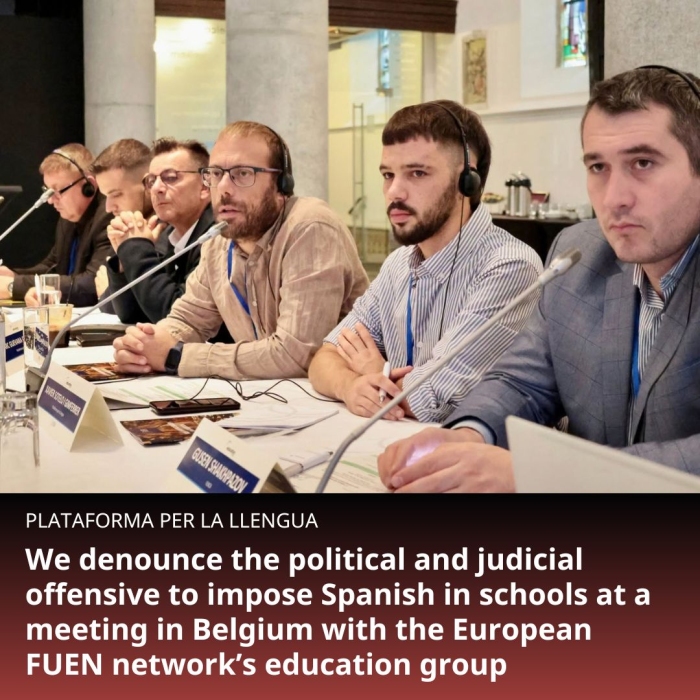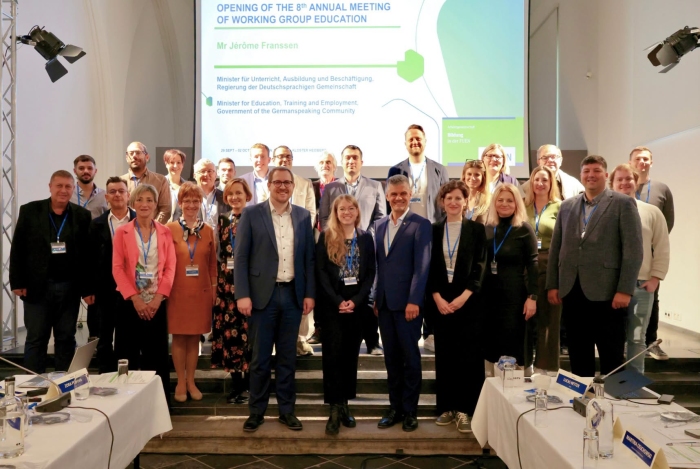


This week, Plataforma per la Llengua has taken part in the annual meeting of the education group of the Federal Union of European Nationalities (FUEN), one of the main organisations intended to protect national and language minorities. The meeting was held between 29 September and 2 October in Eupen, capital of Deutschsprachige Gemeinschaft Belgiens (the German-speaking region of Belgium). It brought together representatives of various European minorities to debate current educational challenges, particularly concerning professional training and the use of artificial intelligence. The organisation for the protection of Catalan deplored the unceasing political and judicial attacks against schooling in Catalan, and warned that the courts are continually opening up new ways to increase the presence of Spanish in schools.
The organisation explained the relevant case of El Pi Gros Primary and Secondary School at Sant Cebrià de Vallalta, where the High Court of Justice of Catalonia (TSJC) has applied the doctrine of the European Court of Human Rights (ECHR) to force the school to teach more subjects in Spanish to one girl's class. It also warned that the TSJC now accepts the arguments of July's Supreme Court decision that opens the door to including Spanish in signage at schools and colleges in the public system.
In front of representatives of other European minorities, Plataforma per la Llengua also deplored the exclusion of Catalonia from the results of the PISA tests because of poor management of the sample of pupils, and warned of the risks of this for the assessment of the country's education policies. In addition, it presented the manifesto A l'escola catalana, la llengua no es toca! (In Catalan schools, leave the language alone!), being promoted this September to call for urgent measures to strengthen linguistic immersion. Plataforma per la Llengua explained that petitions have already been passed on to teachers' unions so they can incorporate their demands in negotiations with the Department of Education and Vocational Training.
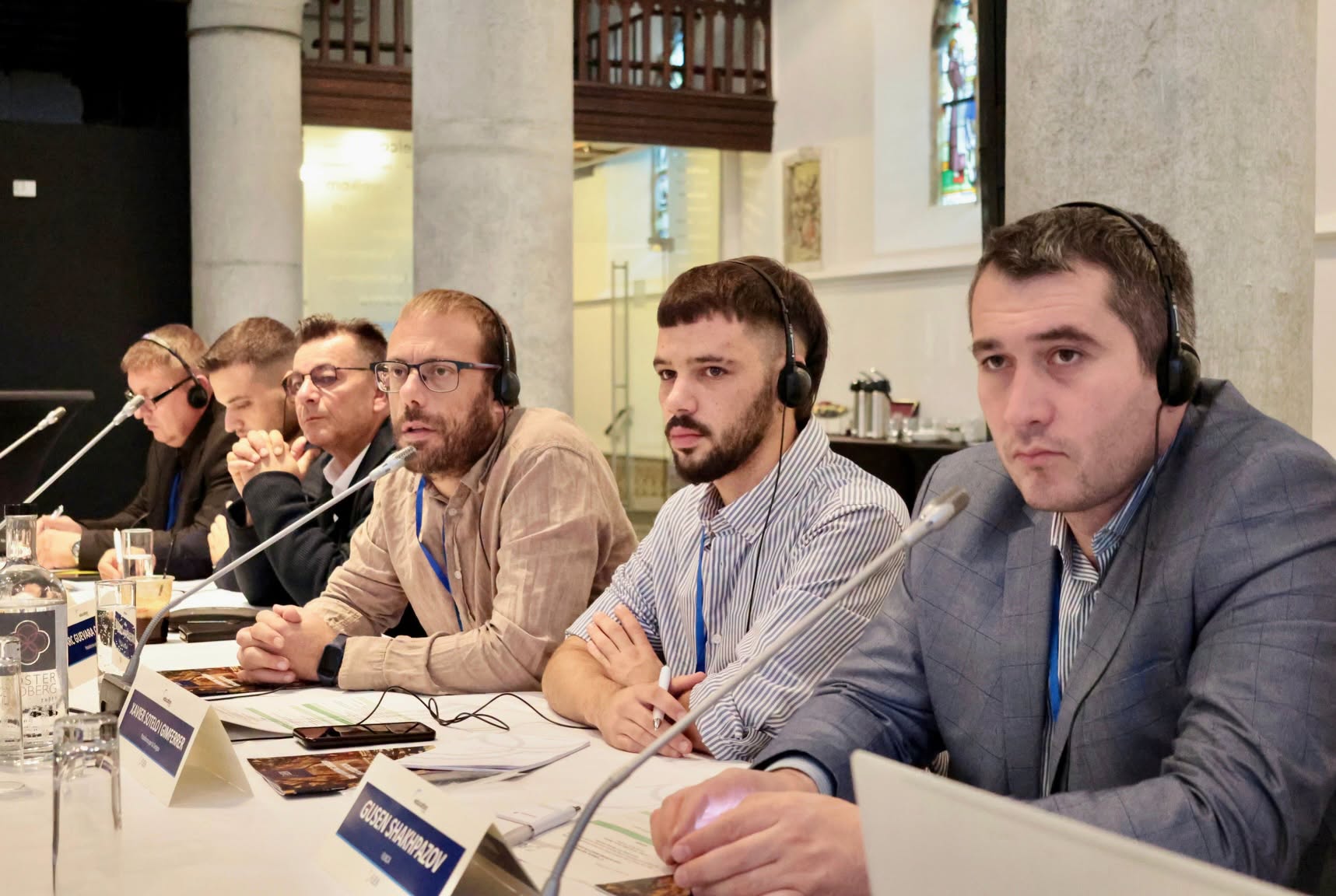
A meeting to find out about the situation in the Deutschsprachige Gemeinschaft Belgiens
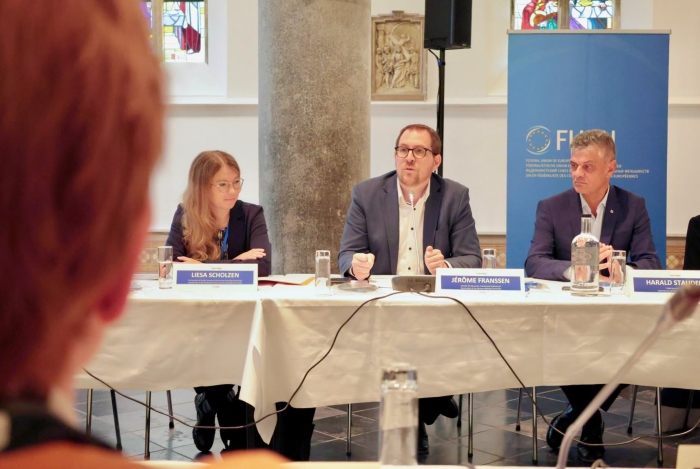
This year's meeting of the FUEN education group - the eighth of its kind - focused on the challenges of vocational training for national and language minorities, as well as the opportunities and risks raised by artificial intelligence in education. The event was opened by Harald Stauder, vice-president of FUEN and spokesman for the education working group, and Jérôme Franssen, Minister of Education, Training and Employment with the government of the Deutschsprachige Gemeinschaft Belgiens. Another speaker was Liesa Scholzen, copresident of the regionalist ProDG party and senator for the German-speaking community, who provided an introduction to the social and institutional situation of the Belgian German-speaking minority.
The first working day was devoted to analysing the educational situation of the host minority. Taking part were, Ruth de Sy, head of the regional government's Department of Education, and Dr Verena Greten, executive director of the Institute for Training and the Improvement of Small and Medium-Sized Enterprises (IAWM). Participants visited the ZAWM Eupen vocational training centre, an institution combining classroom teaching with practical learning with companies that is considered to be one of the key elements of the Deutschsprachige Gemeinschaft's dual training system. There was also a chance to visit the Parliament of the Belgian German-speaking community to find out how the institution works.
The second working day was for finding out about best practice in vocational training for European minorities. Taking part were Alen Vugrinec, who spoke about vocational training among minorities in Slovenia; Pieter de Zwart, whose talk set out for attendees the Frisian vocational training system and multilingualism in the Netherlands; Milan Vukelić, who described education policies for minorities in Croatia; and Eeva-Liisa Rasmus-Moilanen, of the Sami Education Institute in Finland, who explained the role of vocational training in revitalising minoritised languages in her country. The participating organisations then presented reports on the education situation in their communities and shared the most recent challenges they face. It was in this context that Plataforma per la Llengua set out the current situation of Catalan in schools and the latest judicial threats to the Catalan education model.
Finally, the meeting devoted a specific session to the impact of artificial intelligence on the education of language minorities. The introductory speech was by Jakub Osuchowski, and then a debate was opened up on the possible effects of the new artificial intelligence tools for minoritised languages.
Plataforma per la Llengua has been a full member of FUEN since 2024
FUEN is the main defender of national minorities and indigenous language groups in Europe, and brings together more than 100 organisations from 36 European States. The organisation began in Versailles in 1949 to provide different nations and minorities with a proper role after the Second World War. Plataforma per la Llengua began participating as a supporting member in 2018. In October 2022 it became an associate member of FUEN and it has been a full member since 2024.