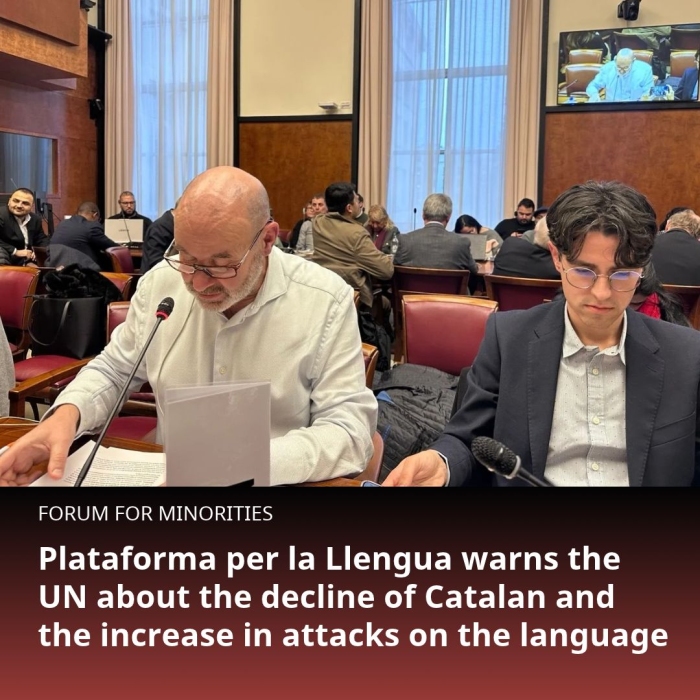


Plataforma per la Llengua has warned the United Nations' special rapporteur for minority issues, Nicolas Levrat, of the decline in Catalan and the increase in discourses opposed to Catalan-speakers' language rights. This Wednesday (25 November), in Geneva, the organisation passed on to him its concern about threats to language immersion in schools, the lack of guarantees for language rights in areas like justice and health, and the situation of Catalan in the different regions. On Thursday, at the UN's Forum for Minorities, the president of Plataforma per la Llengua, Òscar Escuder, stressed the need to strengthen the territorial monitoring of minority language rights and the role of European bodies like the Committee of Experts of the European Charter for Regional or Minority Languages (ECRML).
During yesterday's meeting with Nicolas Levrat, the organisation set out the situation of the language in Catalan-speaking areas, and warned of deficiencies in the application of mechanisms to guarantee language rights and the possible worsening of the situation. It also warned of the possible consequences of a possible change of government in Spain after the 29 November elections, particularly on issues like language immersion in Catalan schools and the use of Catalan in State institutions.
The organisation went on to deplore the fact that Catalan is still at a disadvantage compared to Spanish and French because of the legal supremacy for these languages recognised in the Spanish and French constitutions, all legislation, and the way it is applied. For Plataforma per la Llengua, this inequality is translated into difficulties and failings in essential areas like education, justice and health, and also in no less important areas like sport, videogames or films, which are crucial for the future of Catalan but where the language lacks the necessary institutional support, while Spanish institutions directly or indirectly favour the presence of Spanish.
In front of the rapporteur, the organisation noted that language rights are still not fully guaranteed and it pointed to the legal attacks against language immersion in Catalan schools, the difficulties facing teaching in Catalan in areas like the Valencian region, the Balearic Islands and the Franja in Aragon, and the lack of guarantees ensuring the public can have normal relationships in Catalan with the judicial authorities or the health services.
The organisation also highlighted the situation in North Catalonia. Although sociolinguistic studies show broad social support for the language (79% of people want bilingual education in Catalan, 74% would like to learn it and 63% support official status for Catalan), only 20% of pupils have contact with it during their education, compromising the transmission and future knowledge of Catalan.
Levrat notes that the attacks on Catalan could destroy the language community and says he will closely monitor the case of Spain
The warnings received a response from the United Nations' rapporteur. Nicolas Levrat gave assurances that he is closely monitoring the case of Spain and warned that when a State acts to interrupt the transmission of a language it endangers the continuity of a whole language community.
The rapporteur's words came after contributions from about 100 representatives of civil society organisations from all over the world taking part in a working sessions focused on the protection of minority rights.
Escuder champions the work of the ECRML Committee of Experts and calls for the monitoring of the situation of Catalan to take the different contexts into account
This Thursday lunchtime, the president of Plataforma per la Llengua, Òscar Escuder, spoke at the United Nations' Forum for Minorities to highlight the importance of taking the specific features of each area into account when monitoring the situation of language minorities. He did so accompanied by the president of the European Language Equality Network (ELEN), Davyth Hicks. Plataforma per la Llengua is a member of the network.
In his speech, Escuder gave the example of Catalan and reminded his audience that the situation of the same language community can vary considerably depending on the political, legal and sociolinguistic context in each area, emphasising that protection policies cannot be based on uniform approaches.
For this reason, the president of the organisation championed the work of the Committee of Experts of the European Charter for Regional or Minority Languages of the Council of Europe (ECRML), which, in its assessment reports, analyses the situation of each language in the specific area where it is spoken and formulates specific recommendations adapted to the needs of each situation.
Escuder also praised the role of civil society organisations in protecting minoritised languages as they are the ones who first detect violations of rights, document everyday discrimination and provide specific solutions to the problems facing language communities.
The president of Plataforma per la Llengua concluded by stating that the effective protection of minority rights requires not only the application of solid legal frameworks but also recommendations sensitive to the situation in each area, effective monitoring mechanisms, and significant participation in decision-making processes by the communities they affect.
19th session of the Forum on Minority Issues
The Forum on Minority Issues is organised every year and is intended promote dialogue and cooperation on issues relating to national, ethnic, religious and language minorities, as well as collecting proposals to improve the international protection of these communities.
This year's session is intended to look in depth at the promotion of minority rights through regional cooperation initiatives and mechanisms. As well as Plataforma per la Llengua and other civil society organisations; the Office of the United Nations High Commissioner for Human Rights, run by Volter Türk; and representatives of States, regional bodies and international organisations for the protection of language rights, such as the European Language Equality Network (ELEN), also take part in the event.
Levrat will summarise the contributions made by all the organisations in a set of demands and recommendations which he will present to the United Nations Human Rights Council in March 2027.